Edgbaston: the history of the cricket ground
Researched 8 October 2026 · Club archives and primary sources
Edgbaston began as Warwickshire’s answer to the need for a Birmingham ground. Its history takes in a riverside site opened in 1886, a rain-hit first Test, women’s World Cup cricket, Lara’s 501 and the two-run Ashes finish. The modern South Stand and the next western development show how much has changed around that familiar field.
History at a glance
A timeline of Edgbaston
- 1882Warwickshire County Cricket Club is founded. [1]
- 1885The club agrees the lease for its Birmingham ground. [2]
- 1886Warwickshire plays MCC in the opening match. [1]
- 1902Edgbaston hosts its first Test, against Australia. [1]
- 1973England wins the decisive last match of the Women’s World Cup. [4]
- 1994Brian Lara scores 501 not out for Warwickshire. [5]
- 2005England wins the Ashes Test by two runs. [6]
- 2011A major redevelopment is completed. [7]
- 2022Women’s T20 cricket is played here at the Commonwealth Games. [8]

Why Warwickshire chose Birmingham
Warwickshire was founded in 1882, four years before its first match at Edgbaston. William Ansell argued for a Birmingham base because of the city’s population, after Rugby and Leamington Spa had been considered. The choice mattered: a county club had to decide where it could build an audience and a usable home, not merely select a picturesque piece of grass. Birmingham’s scale was part of the case for the ground from the beginning. [2]
The chosen site was twelve acres beside the River Rea, previously grazing land on the Calthorpe Estate. The committee decided to lease it in June 1885, with drainage and fencing among the initial works. Fundraising and the Cricket Ground Company helped turn a proposed venue into a working ground. Warwickshire’s first match there was against MCC on 7–8 June 1886. The sequence gives you three distinct milestones: the county club’s foundation, the land agreement and the opening of the ground itself. [2] [1]
The first Test and the county’s own milestones
Edgbaston’s first Test came in 1902, against Australia. A permanent stand was erected for the occasion, with temporary seating brought from Villa Park. Australia was dismissed for 36, but rain left the match drawn. It is a reminder that a famous score and a decisive result are not always the same thing: the ground’s first international landmark included both remarkable bowling and lost playing time. Its early history already involved adapting facilities for a larger audience. [1]
Warwickshire’s first County Championship title followed in 1911. The club also records a crowd of 28,000 for a 1951 county match against Lancashire. Treat that as a historical attendance figure, not the present ground’s capacity. County cricket was capable of drawing its own substantial audiences, and the ground’s domestic story should sit alongside its England matches. The Bear and Ragged Staff, adopted on Warwickshire’s caps in 1885, connects those early club decisions with an identity supporters still recognise. [3] [2]
Women’s cricket before the men’s World Cup
Edgbaston staged the decisive final match of the 1973 Women’s World Cup. England beat Australia by 92 runs and won the tournament. This was two years before the first men’s World Cup. The competition used a round-robin format, with this last fixture deciding the title. The achievement is part of Edgbaston’s international history on its own terms, not a footnote to events in the men’s game. [4]
Women’s T20 cricket returned on another multi-sport stage when Edgbaston hosted the Birmingham 2022 Commonwealth Games tournament. That places the ground within the city’s wider sporting history as well as the county’s. For a visitor, these two milestones offer different ways to understand the venue: the earlier world competition and the later Games used the same cricket setting for audiences assembled around different kinds of event. Both belong beside the familiar Ashes stories. [8]
Lara’s 501 and cricket after dark
On 6 June 1994, Brian Lara completed 501 not out for Warwickshire at Edgbaston. The ground’s 501 Suite commemorates the innings, including a tiled wall that records it ball by ball. The number is therefore more than an isolated entry in a record book: it has become a room name and a feature of the venue’s interior. The suite is a separately accessed space, so its existence is a historical landmark rather than a promise that a public seat includes a visit. [5]
In 1997, Warwickshire beat Somerset by 35 runs in Britain’s first competitive floodlit day-night cricket match, according to the club’s history. Edgbaston later hosted the UK’s first day-night Test in 2017, when England beat West Indies by an innings and 209 runs. The two events are twenty years apart and involve different formats. Together they show the ground’s place in changes to cricket’s timetable, from domestic play under lights to an international Test extending into the evening. [1]
The two-run Ashes match
England’s two-run victory over Australia in 2005 finished when Steve Harmison dismissed Michael Kasprowicz, caught by Geraint Jones. The margin and the final wicket explain why the match is so closely associated with Edgbaston: an Ashes Test reached its conclusion with almost nothing between the sides. The ECB’s retrospective preserves the result, while Warwickshire’s own account recalls the finish. For supporters who remember watching it, the score alone can bring back the final moments. [6] [12]
If you first came to cricket through that series, it can be tempting to read the whole venue through one summer. The longer history offers a richer picture. A county club searching for a Birmingham home, a first Test interrupted by rain, a women’s world competition and Lara’s enormous innings all predate it. Keeping those stories together makes Edgbaston a place with several identities: a Warwickshire home, an England stage and a stadium used for the city’s larger occasions.
Redevelopment and the next chapter
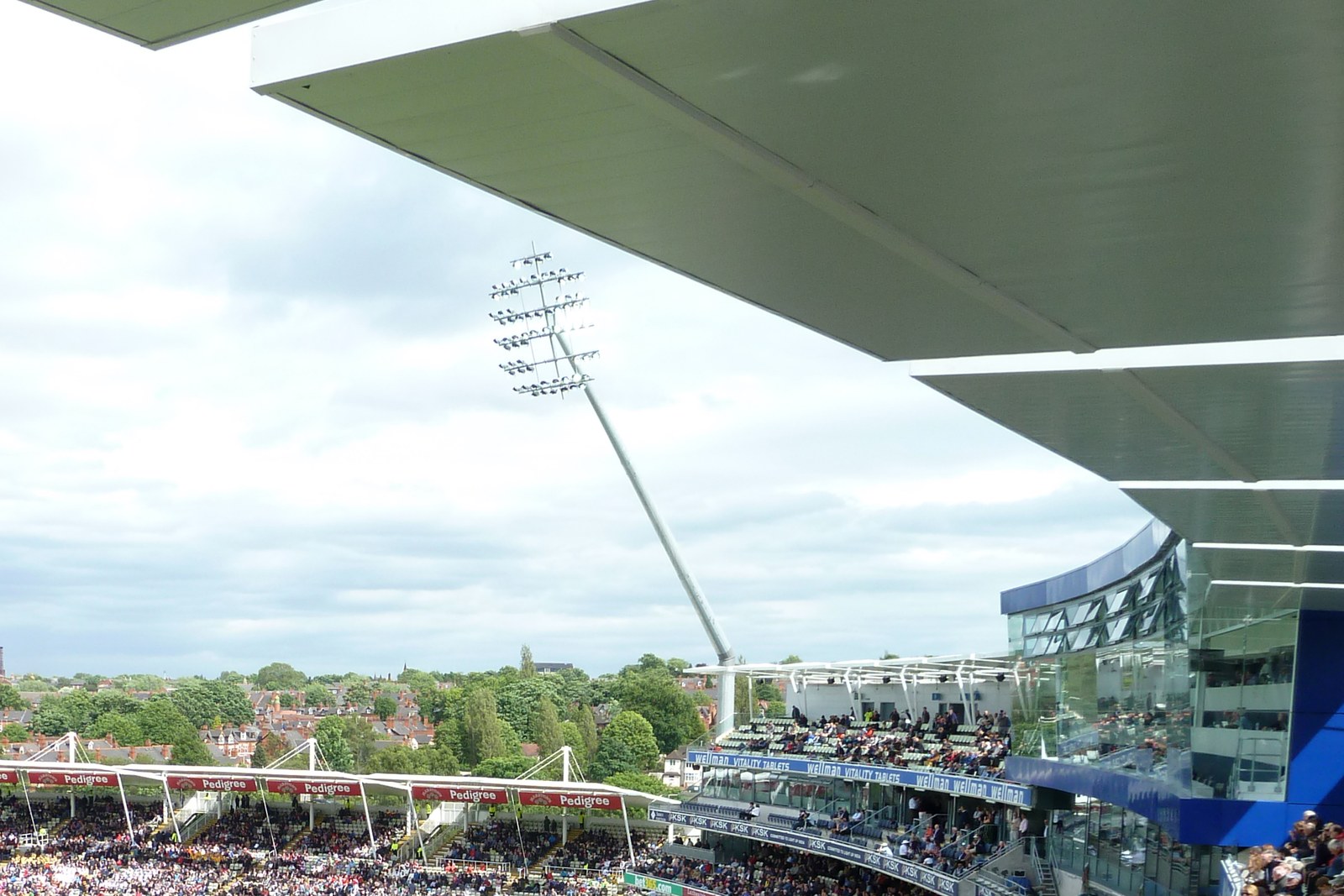
A major redevelopment was completed in 2011, part of the transformation that gives the southern side its modern appearance. The current Pavilion and South Stand should not be confused with the older buildings in archive photographs. When comparing images, start with the date and the part of the ground shown. Cricket photographs can preserve a familiar square while the spectator buildings behind it belong to a different generation. The ground’s own redevelopment account records the 2011 work. [7]
The next western chapter was still in progress when this history was researched in October 2026. Demolition of the Raglan and Priory stands, originally opened in 1958, began in December 2025. Their replacement includes the announced 3,200-seat Dennis Amiss Stand and a Radisson RED hotel, with the 2027 men’s Ashes identified as the first operational major-match day for the new stand. These are published plans, not a completed opening to add retrospectively to the timeline. Use the current visitor and stand guides for booking arrangements during the changes. [9] [10] [11]
What to look for on your visit
- The southern building. The modern Pavilion and South Stand belong to the redevelopment era, rather than the original ground. [7]
- The 501 name. The named suite commemorates Lara’s 1994 innings; interior access is separate. [5]
- The western side. Compare the old Raglan/Priory names with the announced Dennis Amiss development. [9]
- Warwickshire’s emblem. The Bear and Ragged Staff connects the present club with its 1885 cap design. [2]
For today’s stands, ticket routes, travel and accessibility, use the Edgbaston visitor guide and accessibility guide.
Sources and further reading
For Edgbaston: ground history, numbered references connect the historical facts above to the ground’s own archives, governing bodies and primary architectural or heritage records.
- Edgbaston: official ground history
- Warwickshire: 140 years of Edgbaston
- Warwickshire: club timeline
- MCC: the 1973 Women’s World Cup
- Edgbaston: the 501 Suite and Lara’s innings
- ECB: England’s two-run win in 2005
- Edgbaston: the completed 2011 redevelopment
- Birmingham 2022: Edgbaston venue
- Edgbaston: Raglan and Priory demolition
- Edgbaston: the next masterplan phase
- Edgbaston: the 2027 Ashes and new stand
- Warwickshire: the 2005 Test finish