The Oval: the history of the cricket ground
Researched 8 October 2026 · Club archives and primary sources
The Oval’s story starts with Surrey’s establishment in 1845 and reaches well beyond cricket. It staged the first Test in England, the match that gave the Ashes their name and the first FA Cup final. Its Pavilion, changing stands and famous gasholder backdrop make the history visible from the seats as well as in the records.
History at a glance
A timeline of The Oval
- 1845Surrey is established and secures its Oval home. [1]
- 1872The first FA Cup final is played at the ground. [2]
- 1880England and Australia play the first Test on English soil. [2]
- 1882Australia’s seven-run victory gives rise to the Ashes name. [3]
- 1948Don Bradman makes his final Test appearance. [5]
- 1952–1958Surrey wins seven successive County Championships. [4]
- 2005The redeveloped Vauxhall-end stand opens. [9]
- 2021The new Pavilion-end development expands spectator facilities. [10]
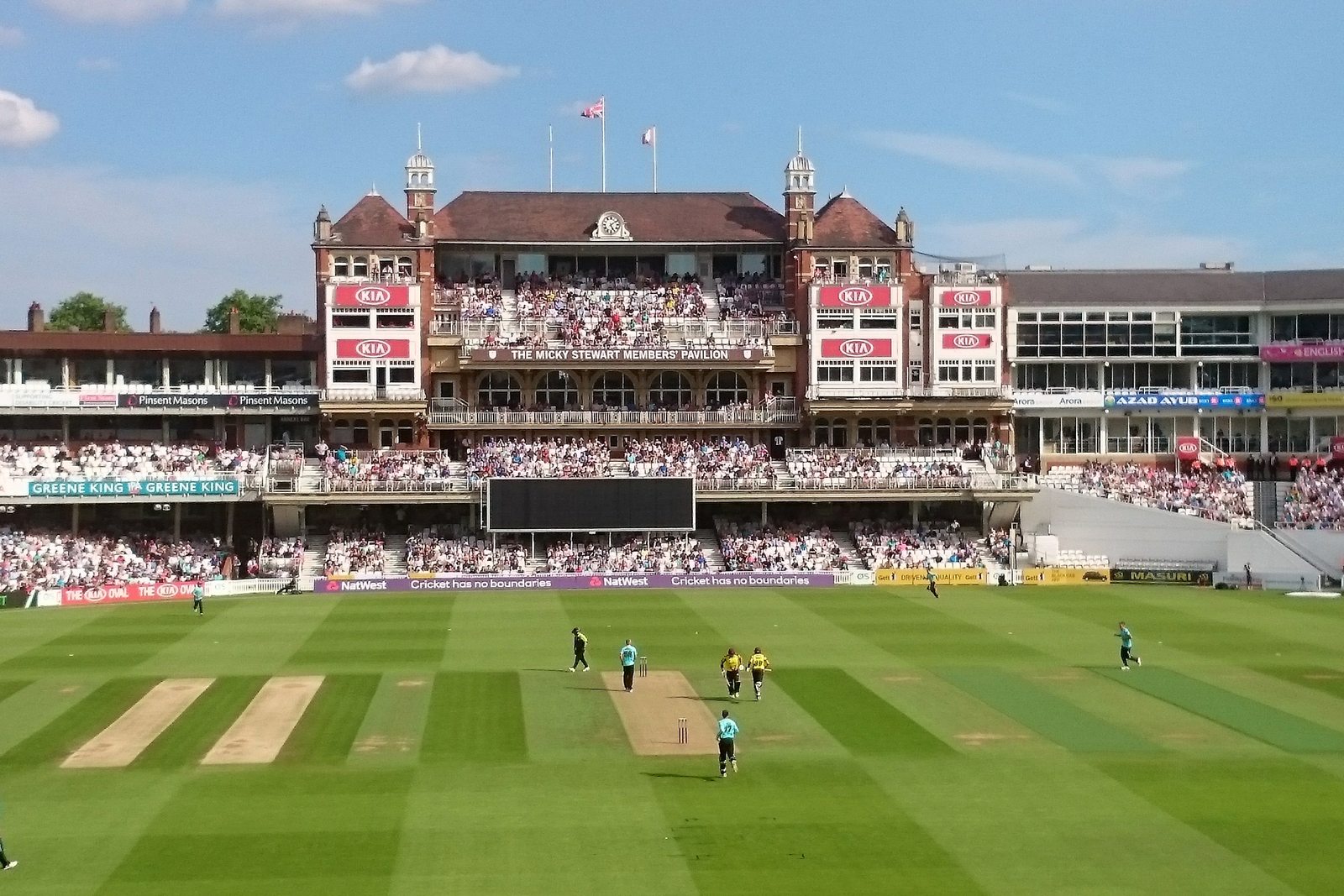

A Surrey home from 1845
Surrey’s foundation and The Oval’s opening belong to the same year. A lease was secured from the Duchy of Cornwall in 1845; an initial meeting in August proposed the county club, and formal establishment followed at the Horns Tavern on 18 October. The tavern has gone, but the cricket ground remains Surrey’s home. It is a useful starting point for a visit: this is a county club’s longstanding base as well as an international venue known across the world. [1]
Surrey won the first official County Championship in 1890 and later put together seven successive titles from 1952 to 1958. Those achievements sit behind the ground’s international reputation. When you watch a county match, you are seeing another chapter of the same story, rather than a lesser use of an England stadium. The names around the ground and in its rooms connect domestic players, captains and club figures with the place where Surrey has played for generations. [4]
Charles Alcock and a ground for more than cricket
Charles Alcock’s work links The Oval with the organisation of English sport beyond the county game. He helped establish the FA Cup, and its first final was played here in 1872. The ground hosted nearly all the finals through 1892. That is a different Oval from the one a modern cricket ticket brings you into: a sporting venue whose field could provide a national stage before the later separation of football and cricket stadiums became familiar. [2]
Alcock also helped bring the first Test on English soil to The Oval in September 1880. England played Australia over three days, with more than 48,000 paid admissions recorded across the match. Those admissions were recorded across the three days. The milestone came before the first Tests at Old Trafford and Lord’s. For cricket history, The Oval’s importance therefore begins before the 1882 result that is its most famous founding story. [2]
The match that gave the Ashes their name
On 29 August 1882, Australia beat England by seven runs at The Oval. England had been set 85 and was dismissed for 77. The narrow defeat prompted the Sporting Times’ mock obituary for English cricket, supplying the idea of its ashes being taken to Australia. The result and the newspaper response are the essential historical sequence: a match played in Kennington became the starting point for a name now attached to a much larger rivalry. [3]
The original Ashes urn is associated with Lord’s Museum, which can confuse a first-time visitor expecting the whole story to belong to one ground. The Oval is the place of the 1882 defeat and obituary; Lord’s tells the later story of the object in MCC’s collection. Read the histories together and the distinction becomes clear. Here, the enduring connection is to the contest on the field and the reaction it provoked, rather than to an object displayed above a particular seat. [14]
War, restoration and the 1948 farewell
The Second World War interrupted the ground’s normal life. It was requisitioned in 1939 and prepared as a prisoner-of-war enclosure, but never used for that purpose. The preparations still damaged the cricket ground: huts, posts and other installations had to be dealt with before a full return to play. Surrey’s account of its interrupted 1945 centenary makes the physical work of recovery part of the history, not simply a gap between seasons. [6]
The ground was restored for the following season under groundsman Bert Lock. Then, in 1948, it hosted Don Bradman’s last Test. He needed four runs to finish with a Test average of 100, but was dismissed without scoring and ended on 99.94. The numerical detail has become inseparable from the venue’s reputation for farewells. It also places a celebrated cricket moment very close to the much less glamorous task of bringing a wartime ground back into use. [5]
County dominance and summer finales
The Oval has often staged a summer’s final Test, making it a natural setting for decisions, departures and celebrations. In 1953, England regained the Ashes here with an eight-wicket win. The county side’s seven-title run was unfolding in the same decade. Looking back at that period shows how two stories can inhabit one field: Surrey’s repeated domestic success and England’s attempt to recover a rivalry after years without the urn. [7] [4]
More recent memories include the drawn 2005 Test that completed England’s Ashes series victory and Alastair Cook’s century in his final Test in 2018. These are different kinds of finale: a series being secured and a player making his last appearance. The ground also began a new competition’s history in July 2021, when Oval Invincibles women beat Manchester Originals in The Hundred’s first match. Its story keeps expanding rather than ending with the familiar nineteenth-century landmarks. [8] [13]
The stands and the gasholder backdrop
The large Vauxhall-end redevelopment opened in 2005. Architect Populous describes the lightweight polycarbonate-and-steel roof of the stand then known as the OCS Stand. At the Pavilion end, One Oval Square became the M.A.R. Galadari Stand in 2021, adding seating and incorporating the Peter May, Laker and Lock terraces. Surrey announced its renaming as the SSE Energy Solutions Stand in 2025. Those naming changes matter when reading old reports: a new sponsor’s name does not necessarily mean a new building. [9] [10] [11]
Outside the boundary, Gasholder No. 1 is another recognisable part of the cricket view. Historic England dates the surviving structure to 1877–79 and records its Grade II listing in 2016. It is industrial heritage beside sporting heritage, not a cricket stand. Looking towards it helps place The Oval in its London neighbourhood, while looking back across the field reveals the mix of Pavilion, redeveloped spectator buildings and remembered players that gives the ground its own identity. [12]
What to look for on your visit
- The Pavilion end. Compare the older Pavilion setting with the 2021 development beside it. [10]
- The Vauxhall-end roof. The 2005 redevelopment is a modern chapter in the ground’s architecture. [9]
- Peter May, Laker and Lock. These names survive within the newer Pavilion-end building. [10]
- The gasholder. The listed nineteenth-century structure belongs to the surrounding industrial landscape. [12]
For today’s stands, ticket routes, travel and accessibility, use the The Oval visitor guide and accessibility guide.
Sources and further reading
For The Oval: ground history, numbered references connect the historical facts above to the ground’s own archives, governing bodies and primary architectural or heritage records.
- Surrey: 180 years of the club and ground
- Surrey: Charles Alcock’s legacy
- Surrey: the 1882 Ashes match
- Surrey: club history
- Surrey: Bradman’s final Test
- Surrey: the interrupted 1945 centenary
- Surrey: the Ashes from 1953 onwards
- Surrey: memorable final Tests
- Populous: the 2005 stand design
- Surrey: the 2021 One Oval Square development
- Surrey: SSE Energy Solutions stand naming
- Historic England: Gasholder No. 1 listing
- The Hundred: the competition’s opening match
- MCC: the Ashes urn in its collection
Explore the other grounds
- Lord’s history
- Edgbaston history
- Old Trafford history
- Headingley history
- Trent Bridge history
- Taunton history
- Hove history
- Canterbury history
- Chelmsford history
- New Road history
- Derby history
- Grace Road history
- Wantage Road history
- Southampton history
- Sophia Gardens history
- Chester-le-Street history
- Bristol history